Know your alarms.
Five minutes here can save your sleep tonight, and maybe a lot more. No jargon, no scare tactics, just what every homeowner should know.
Trusted across the Valley • 100% satisfaction guarantee • Family-owned & local
The beep decoder:
Your alarm is trying to tell you something. Here's the translation.
●
1 CHIRP / MINUTE
Low Battery
The classic 3 a.m. visitor. Cool overnight air pushes a weak battery below its threshold.
Replace Battery
●
STILL CHIRPING AFTER NEW BATTERY
End of life or a fault
The sensor is worn out or there's a wiring problem. No battery fixes this one.
Contact us
●●●
THREE LOUD BEEPS, REPEATING
If there is smoke, get everyone out, then call 911 from outside. If verified there is no smoke, contact us.
Smoke detected or false alarm
Get out, call 911
No smoke, contact us
●●●●
FOUR LOUD BEEPS, REPEATING
You can't see or smell CO. Get to fresh air immediately and call 911. If the fire department verifies there is no CO, contact us.
Carbon monoxide or false alarm
Fresh air, call 911
10
YEARS
Alarms expire. Really.
Every smoke alarm wears out after about 10 years, even hardwired ones, even if the test button still beeps. They are required to signal end-of-life by chirping every minute or two. The manufacture date is printed on the back of the unit.
Standards changed too: alarms built to UL 217 8th Edition (2025) are far better at ignoring burnt toast while catching slow, smoldering fires sooner. If yours predate it, an upgrade isn't a luxury, it's the difference the standard was written for, to better protect your family.
Where alarms belong.
Most homes we visit are under-protected. Here's what full coverage actually looks like.
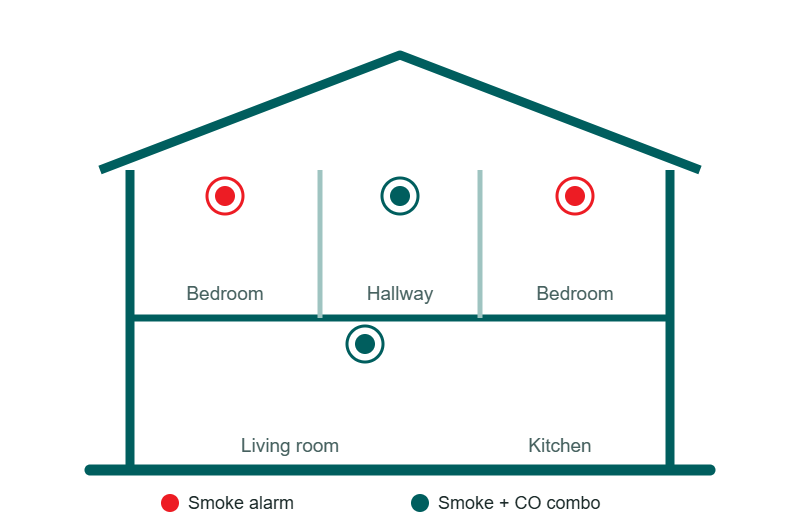
✓ Inside every bedroom
✓ At least one on every level
✓ CO protection near bedrooms
✓ In the hallway outside sleeping areas
✓ Near (not in) the kitchen
✓ Interconnected, so they all sound together
Not all alarms are equal.
Different alarms catch different threats. The right answer is usually a mix, matched room by room.
Modern alarms that meet UL 217 8th Edition (2025) standards are designed to avoid false alarms and are better at detecting both smoldering and flaming fires.
Modern smoke alarms
Adds carbon-monoxide detection, the invisible risk from furnaces, water heaters, and attached garages.
Smoke + CO combo
The two-minute monthly habit:
✓ Press and hold the test button on every alarm once a month.
✓ Never paint over an alarm, and never "borrow" its battery.
✓ Replace batteries (if replaceable) once every year.
✓ Vacuum the alarms once a year. Dust and bugs cause false alarms.
✓ Walk your two-ways-out escape plan with the family twice a year.
✓ Schedule annual alarm maintenance with SMOKE ALARM EXPERTS.
Learn more...
Dig deeper and find answers to the most commonly asked questions about smoke alarms and fire safety.
-
A single chirp every minute or two is almost always a low battery. If a fresh, quality battery doesn't fix it, it usually means the alarm is faulty or has reached its 10-year lifespan. Work through it in order: replace every battery, clean the vents with canned air, reset the unit (cut power, pull the battery, hold the test button ~30 seconds), and call us to replace it if it still chirps. And never just disconnect or yank the battery to silence it; a disabled alarm is the most common thing fire departments find in homes that didn't get warning in time.
-
Nuisance alarms almost always come down to the wrong sensor type, the wrong spot, or an aging or faulty unit. The fixes are simple: use modern alarms that are designed to reduce false alarms, use the right sensor near kitchens and bathrooms, clear out dust and insects, and replace all alarms when they near the 10-year mark. Newer 2025-standard alarms are built specifically to ignore cooking smoke and steam. Whatever you do, don't disable it — contact us to fix it so it only sounds when it actually matters.
-
It's not haunted — it's physics. A weak battery puts out slightly less voltage as the house cools overnight, and that dip is exactly what trips the low-battery chirp at 3 a.m. The fix: replace the batteries in all your alarms, not just the noisy one, with fresh quality batteries. If it keeps chirping after that, the alarm is likely past its 10-year life; contact us for a replacements.
-
Usually all of them — and here's the honest reason. Most alarms get replaced because they've reached their 10-year end-of-life, so if one's expired, the others are right behind it. Doing them together is safer and cheaper than paying for repeat visits.
There's also compatibility: your current model may be discontinued, and newer alarms often won't link up with older ones. For interconnected systems that really matters — they all have to work together and "speak the same language," or some won't alert when they should or you could false alarms.
The exception: if your alarms are fairly new, still available, and just one is defective, then yes — we can swap that single unit with a matching model. Either way, we'll tell you honestly which situation you're in.
Chirping & false alarms
-
Sometimes yes, sometimes we'd rather you didn't. A single battery-powered alarm you can comfortably reach? Swap it yourself — easy. The trouble starts with hardwired systems, common in most homes built since the early '90s: they run on 120-volt house power, they're usually on high ceilings, and they're interconnected so they all alert together. That combination — live wiring plus a tall ladder — is how people get hurt. And the interconnect is fussy: mix in the wrong brand or an incompatible model and the system can false-alarm constantly, or worse, stay silent when it matters most. Battery-only and within reach? Go for it. Hardwired, interconnected, or up high? That's a job worth handing off.
-
Five things matter:
It meets the 2025 (UL 217 8th Edition) standard
It's a mid-to-high-quality unit from a reputable brand (bargain alarms underperform in real testing)
It has the right power setup (hardwired with battery backup for homes built after the early 1990s, or battery-only for older homes)
It's interconnected so one alarm trips them all
It includes CO detection where you have combustion appliances or an attached garage
This is the one device that has to work on its worst day — skip the bargain bin.
-
These are by far our most popular alarms, and it's easy to see why. If you want fire safety you can genuinely forget about, this is it: the battery is sealed in for the life of the unit, so it's one install and then a full decade with no batteries to buy, no low-battery chirp at 3 a.m., and nothing to put on your calendar. They also satisfy the sealed-battery rules now on the books in a lot of places, so you're covered there too.
The only fine print: a "ten-year" battery can run a little short of ten in real-world use. But that's right about when the whole alarm is due for replacement anyway — so the battery and the unit simply retire together, you drop in a fresh alarm, and the clock starts over.
One thing worth saying, though: "no battery to change" isn't "nothing to do." It's still smart to press the test button every month and clear the dust out at least once a year — dust and our desert insects are the most common cause of false alarms, and a quick vacuum keeps the sensor reading clearly. Two minutes of attention, and your set-and-forget alarm stays exactly that.
-
Carbon monoxide is colorless, odorless, and can be deadly — and its early signs (headache, dizziness, nausea) are easy to miss. You need CO alarms if you have any fuel-burning appliance, gas heat, a fireplace, a generator, or an attached garage. Explosive-gas alarms add a layer if you use natural gas or propane. Put one on every level and outside sleeping areas (keep them a few inches off corners), and replace CO units every 5–7 years — or 10 if they're combined with a smoke alarm.
-
Smart alarms can message your phone when they trip or tie into home automation — genuinely handy if you travel or have a second home. But they cost a lot more (sometimes with a subscription), and the smarts don't help much if only some of your alarms are upgraded. Being smart also doesn't mean they are better at detecting smoke; an alarm's single purpose. Get the fundamentals right first — every unit interconnected, meeting current standards, and matched. If a smart alarm checks all those boxes, and you have the budget to make them all smart, go for it.
-
For smoke alarms, yes — buy the best. We use Duracell Copper Top or Engergizer Max exclusively. In our experience they last longer and fail less than the alternatives. Replace them once a year (tie it to a season change so it's easy to remember), and toss the freebie battery that ships with a new alarm — start it fresh. Cheap or tired batteries are the real reason behind that 3 a.m. chirp. Make sure to change the batteries in all your alarms, not just the one that is chirping.
-
As of January 1, 2025, new alarms meet must the UL 217 8th Edition safety standards, and it's a real upgrade. Smarter sensor electronics catch both fast flames and slow, smoldering fires sooner, while built-in microprocessors tell a genuine fire apart from cooking, steam, or dust — so you get far fewer nuisance alerts. Many areas now require the new standard to meet code. If your alarms predate 2025, they're worth replacing.
-
A smoke alarm has the siren built into the unit — and can link to others so they all sound together — which is what's in nearly every home. A smoke detector senses smoke and reports to a separate panel, like a monitored security system, without its own siren. In everyday conversation the terms get used interchangeably; unless yours ties into a security system, you have smoke alarms.
Choosing the right alarm
-
Four quiet failures put homes at risk: alarms over 10 years old (check the date on the back — yellowing is a giveaway), alarms that were disabled after one too many false alarms, alarms that never get fresh batteries or cleaning, and the wrong type or placement for the room. Any one of them can mean no warning when it counts. The cure is a 15-minute check — dates, batteries, type, and placement, room by room.
-
Remember PASS: Pull the pin, Aim at the base of the fire (not the flames), Squeeze the handle, and Sweep side to side. Stand 4–6 feet back, and only fight a small, contained fire with a clear exit behind you — if it's growing, get out and call 911.
-
Kids do best with a simple plan they've practiced: know two ways out of every room, get low under smoke, get outside and stay out (never go back for a toy or pet), and meet at one spot out front. Practice stop-drop-and-roll, and teach them that firefighters are friends — never hide from them. We've gathered kid-friendly fire-safety videos to help the lessons stick.Here are some useful YouTube videos for kids about fire safety:
-
Fire blankets make you get right up next to the flames and pulling one away can cause a flare-up — which is why you usually see them demonstrated by a firefighter in full gear. We'd rather you stay back. Keep a medium or large A-B-C fire extinguisher in the kitchen (usable from 4–6 feet away) and consider a stovetop suppression canister that mounts under the range hood and triggers itself if a cooktop fire starts.
Fire Safety
Still have a question we didn't answer?
Every home is a little different. Tell us what's going on and we'll give you a straight answer and a written quote, no pressure.
Call or Text